Public Safety Systems · Autonomous Rescue · BioGlow™ Infrastructure
Aqua Sentinel Network™
A compact autonomous flood-rescue concept for the Los Angeles River — combining soft-capture rescue pods, modular docking infrastructure, BioGlow™ guidance paths, and a new approach to emergency extraction during dangerous storm flow.
Aqua Sentinel Network™ Concept Trailer
A cinematic concept trailer visualizing the Aqua Sentinel flood-rescue system: LA River storm conditions, compact autonomous rescue pods, BioGlow™ guidance paths, soft-capture rescue, onboard safety guidance, and elevated extraction.
Concept video: Aqua Sentinel Network™ — autonomous flood rescue infrastructure for dangerous storm-flow corridors.
Transmission Map
Why the LA River Needs a New Rescue Layer
During heavy storms, the Los Angeles River can transform from a dry concrete channel into a fast-moving flood corridor. The danger is not only water depth. It is velocity, debris, limited access, poor visibility, slick concrete, and the short window between distress and tragedy.
Traditional rescue often depends on human responders entering or approaching a hazardous flood zone after the emergency has already escalated. Aqua Sentinel Network™ asks a different question:
What if rescue infrastructure was already positioned inside the danger corridor — waiting, charged, visible, and ready to respond before human entry becomes necessary?
What Is Aqua Sentinel Network™?
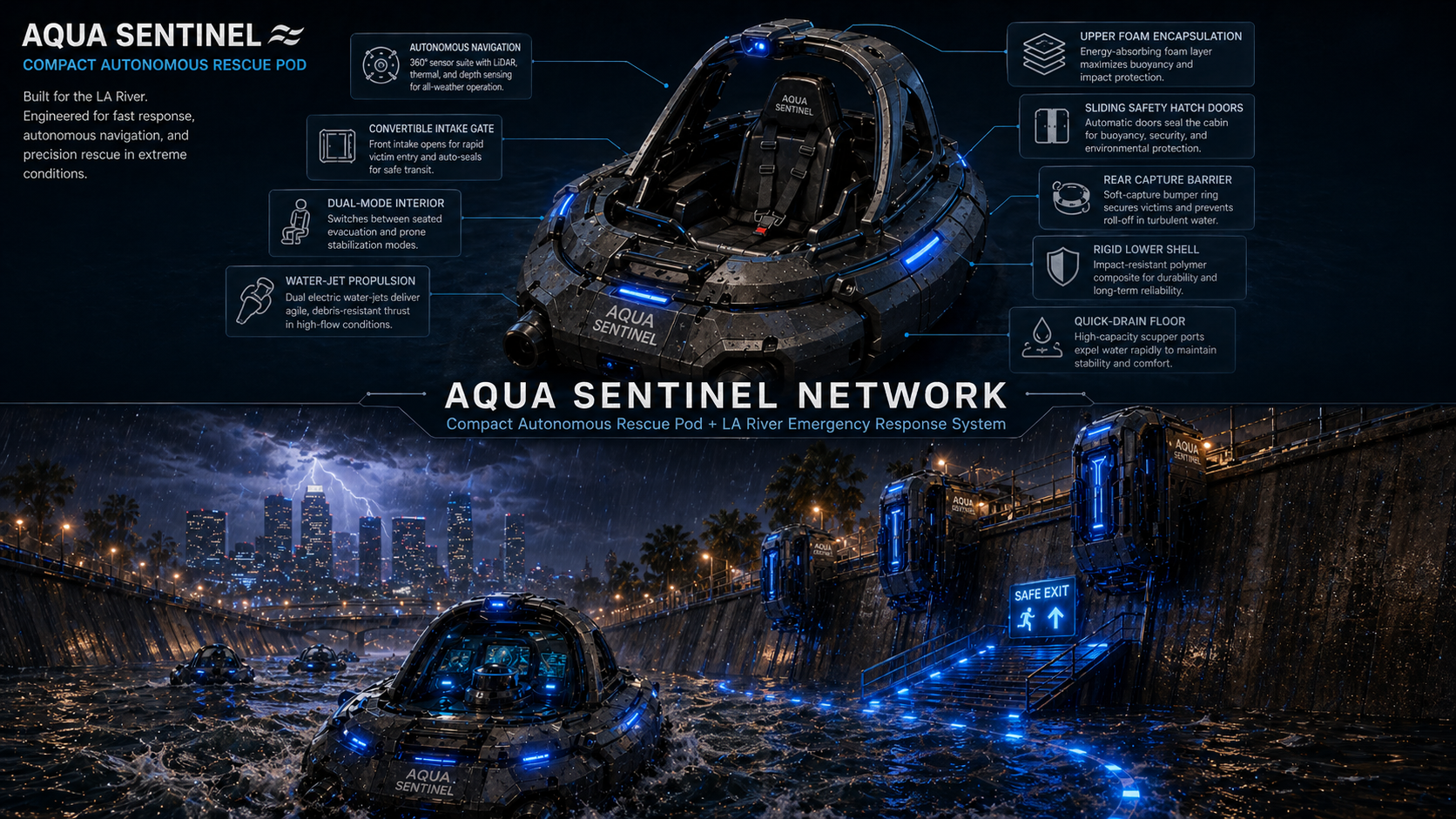
Aqua Sentinel Network™ is a conceptual flood-rescue system designed around compact autonomous rescue pods stationed along dangerous waterways. For the LA River, the system imagines modular docking stations mounted above the flood line, autonomous pods deployed into the channel, and illuminated BioGlow™ guidance routes leading toward safe-exit ramps.
The goal is not to overpower the river like a military machine. The goal is smarter:
The strongest version of this system is not the most expensive one. It is the version that can be phased, serviced, scaled, and eventually tested in controlled environments.
Operational benefit: Aqua Sentinel Network™ could also reduce the need for immediate helicopter deployment in certain flood-rescue situations. Instead of sending human rescuers directly into dangerous water or launching high-fuel-cost aerial response as the first option, compact autonomous pods could provide an early rescue layer inside the flood corridor.
This does not replace helicopters, firefighters, lifeguards, or emergency responders. It supports them. The goal is to keep rescuers safer, reduce unnecessary fuel use, lower response risk, and still accomplish the main mission: reach the person faster, stabilize them, and guide them toward a safer extraction point.
The Compact Autonomous Rescue Pod
The latest Aqua Sentinel pod concept moves away from oversized sci-fi hardware and toward a compact, go-kart-scale rescue vehicle. It is designed to be small enough for rapid deployment, but strong enough to survive violent storm conditions, concrete-wall environments, and debris impact.
Compact Scale
A smaller body reduces cost, simplifies storage, improves deployment speed, and makes multiple units easier to install along a river network.
Autonomous Navigation
A sensor suite may include cameras, depth sensing, low-light vision, thermal upgrades, and navigation logic for storm conditions.
Water-Jet Propulsion
Electric water-jet modules offer maneuverability while reducing exposed propeller risk in debris-heavy water.
Modular Service
Batteries, sensors, bumper sections, hatches, and jet modules can be designed for quick maintenance and field replacement.
This is where the design becomes more believable. Instead of imagining one perfect rescue robot that does everything, Aqua Sentinel is better understood as a modular rescue platform: simple core body, upgradeable sensors, swappable power, replaceable bumpers, and optional protective systems.
Soft-Capture Intake and Dual-Mode Protection
The most important innovation is not the lights, the AI, or the docking tower. The real mechanical idea is the pod’s soft-capture intake geometry.
The front of the pod can convert into an intake gate. The surrounding flotation base helps guide the person inward while allowing water to redirect around the pod instead of creating a hard wall of resistance. Inside, a rear capture barrier prevents the occupant from passing through the pod and being swept back into the flow.
The principle is simple: let the water move, but stop the person safely.
Two Interior Modes
A conscious occupant may be instructed by audio and internal display prompts to sit upright, grab the handles, and fasten the restraint. In this mode, the interior seat rises or locks into a fixed position for controlled evacuation.
If the occupant is unconscious or unable to sit, the interior can remain in a flatter stretcher-like mode. The floor becomes a stable receiving surface while the pod prioritizes containment, drainage, and rapid transport toward the safe exit.
Closure and Protection Sequence
After the occupant is centered, sensors can verify foot clearance and body position. Sliding safety hatch doors close around the lower section to reduce splash, improve buoyancy control, and prevent secondary ejection. The rigid lower shell protects from below while the upper protective system can deploy a foam or padded encapsulation layer for impact absorption and thermal protection.
This transforms the pod from a flotation device into a temporary survival capsule.
BioGlow™ Guided Extraction
BioGlow™ becomes the visual intelligence layer of the system. In storm conditions, darkness and visual chaos can be just as dangerous as water speed. A rescue path needs to be visible to the pod, the victim, responders, and anyone monitoring the scene.
In the Aqua Sentinel concept, BioGlow™ path markers could guide the pod toward safe ramps, identify extraction channels, mark dock locations, and provide low-glare illumination along the flood corridor.
A future version may explore RPAS-inspired light routing through protected optical channels or fiber-optic delivery lines. In that version, light could be transmitted into submerged or semi-submerged guidance markers, carrying modulated frequency patterns through protected optical pathways rather than relying only on exposed conventional fixtures.
Concept integrity note: RPAS/BioGlow underwater routing is an exploratory design direction. It should be treated as a future research pathway until prototype testing confirms brightness, durability, energy behavior, waterproofing, maintenance cost, and real visibility in stormwater conditions.
Deployment Phases: From Practical Start to Full Network
Aqua Sentinel does not need to begin as a massive citywide system. A realistic path starts smaller and scales only after testing, funding, and public-safety review.
Phase 1: Pilot Corridor
Install a small number of docking stations near known high-risk sections. Begin with remote monitoring, manual deployment authorization, and controlled testing.
Phase 2: One-Mile Spacing
Place pods approximately every mile along selected danger zones. This creates initial coverage while controlling cost and maintenance complexity.
Phase 3: Half-Mile Density
As funding expands, add more pods at half-mile intervals to reduce response time and improve contact ETA during fast-moving storm events.
Phase 4: Intelligent Network
Connect pods, docks, sensors, BioGlow paths, safe-exit ramps, and emergency operators into one coordinated rescue layer.
Truth, Integrity, and Real-World Limits
Aqua Sentinel Network™ is a concept system. It is not presented as a completed public safety product. The design would require engineering review, hydrodynamic testing, electronics validation, rescue protocol development, city approval, and controlled trials before any real deployment.
The honest engineering challenges include:
- Stability in high-flow water
- Debris impact resistance
- Safe human capture without injury
- Reliable drainage and occupant positioning
- Battery performance in storm conditions
- Sensor reliability in rain, spray, darkness, and turbulence
- Maintenance cost for public infrastructure
- Emergency responder integration and legal safety requirements
But those challenges do not destroy the idea. They define the work. The mature version of Aqua Sentinel is not fantasy; it is a research direction for turning dangerous flood channels into smarter rescue corridors.
Potential Applications
- Los Angeles River storm rescue corridors
- Urban flood channels
- Reservoir and spillway safety zones
- Canals and industrial waterways
- Seasonal flood-prone areas
- Bridge-adjacent rescue stations
- Emergency response pilot programs
- Public-safety technology demonstrations
Final Transmission
Aqua Sentinel Network™ begins with one urgent truth: when floodwater becomes violent, rescue time collapses. The system is a response to that reality.
It imagines a future where rescue is not only reactive, but built into the environment. Compact autonomous pods wait above the flood line. BioGlow™ paths mark the way out. Safe-exit ramps become part of the rescue architecture. The pod does not try to defeat the river. It uses structure, flotation, guidance, and protective capture to create a survivable path through chaos.
Built above the chaos. Designed to save lives.
Transmission Complete
Aqua Sentinel Network™ is part of the HaloCyberLife future-systems archive: a concept study exploring how public safety, autonomous robotics, illuminated guidance, and infrastructure design can merge into a new generation of emergency-response technology.
Next development path: refine pod mechanics, build a Blender prototype model, create a 30–60 second concept video, and convert the article into a cinematic innovation presentation.
Back to Articles Send Signal