
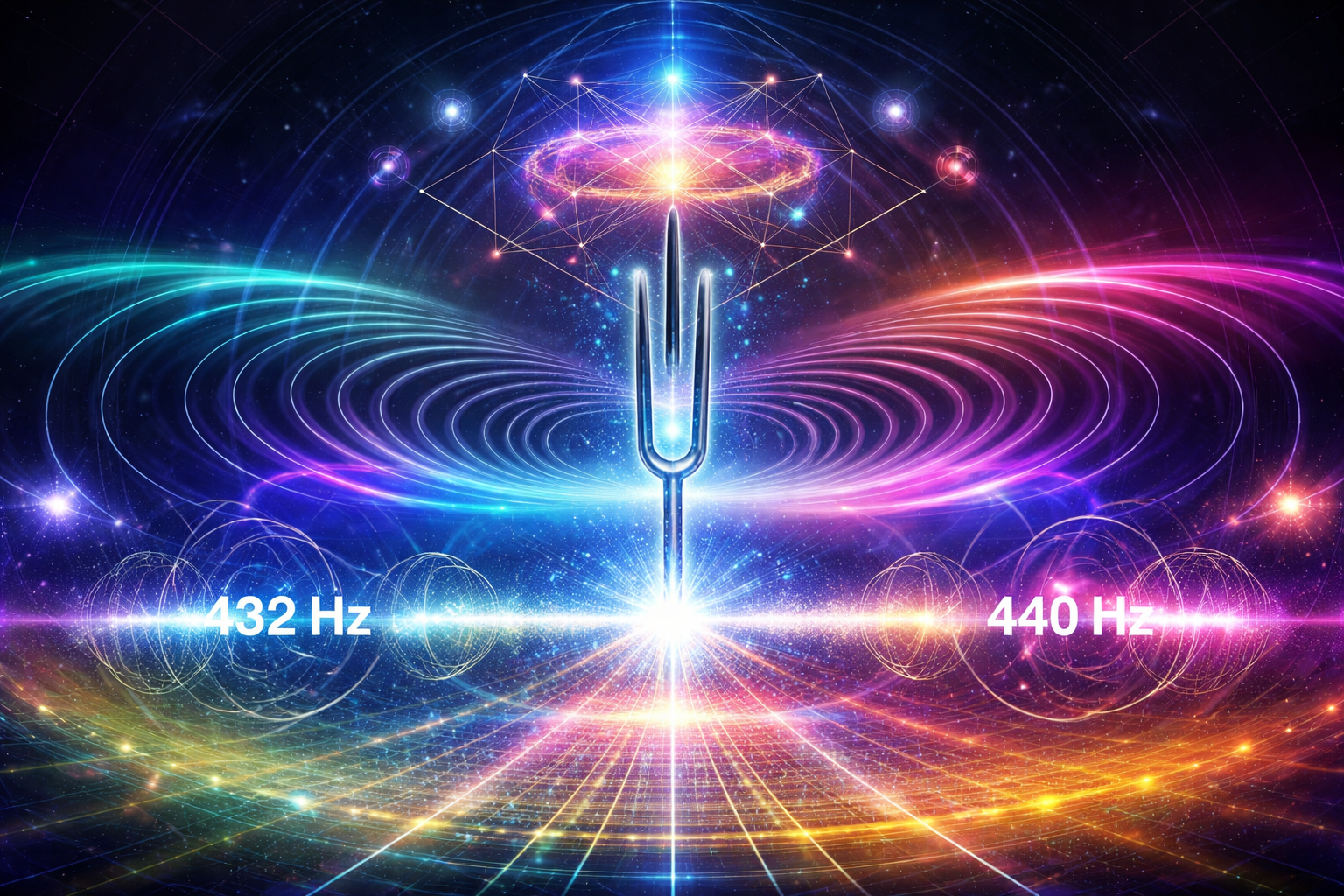
What if the difference between tension and calm is not only in melody, rhythm, or lyrics, but in tuning?
Most modern music is released using a tuning reference known as 440 Hz. It is the accepted global standard, the industrial language of instruments, recording systems, and performance tuning. It exists for consistency.
But standard does not always mean sacred. It means agreed upon.
Beyond that standard exists another tuning that has quietly inspired musicians, listeners, and sound explorers for years: 432 Hz.
Only slightly lower. Barely different on paper. Yet many claim it feels warmer, softer, more spacious, and more natural. Others hear little difference at all. That tension is exactly what makes this worth exploring.
Why 440 Hz Dominates
Modern music did not randomly land on 440 Hz. The standard emerged because large-scale performance, instrument building, orchestras, and recording systems needed a shared reference point. Standardization made music easier to reproduce, easier to coordinate, and easier to industrialize.
In practical terms, 440 Hz became the common operating language of tuning. It optimized music for compatibility.
Core Transmission
Standardization solves the problem of uniformity. It does not automatically solve the question of experience.
That does not make 440 Hz wrong. It simply means it is a system choice, not a final truth.
What Makes 432 Hz So Interesting?
432 Hz is not a different note and not a separate genre. It is an alternative tuning reference. Music tuned or retuned to 432 Hz sits slightly lower in pitch than 440 Hz. The difference is subtle, but for some listeners it changes the emotional character of the sound.
That is where the real conversation begins.
The strongest case for 432 Hz does not require exaggeration. It is enough to ask:
Does a change in tuning influence human experience?
That is a serious question. And it deserves more than internet shouting. It deserves listening, comparison, and direct experience.
Sound and the Human System
Music does not only pass through the ears. It affects mood, breathing, pacing, attention, and emotional state. Rhythm influences the body. Tone influences feeling. Harmonic tension and release influence the nervous system.
Human beings are responsive systems. We react to patterns, intervals, repetition, pacing, and texture. Whether the explanation is acoustic, psychological, symbolic, or all of the above, sound does not merely play around us.
It moves through us.
- Rhythm can regulate or agitate attention.
- Repetition can deepen immersion.
- Tone can soften or sharpen the emotional field.
- Tuning may subtly influence how sound is received.
If that is true, then even a slight retuning may be worth exploring for listeners, creators, and anyone interested in more intentional sound.
Conscious Listening Changes the Conversation
We live in a world flooded with sound but starved for intention. Most people never ask what tuning they are hearing. They consume music passively, the same way they consume noise, stress, and velocity.
But the moment people begin questioning the architecture behind sound, listening changes.
New questions start appearing:
- Why does one version of a song feel more grounding than another?
- Why do some tunings feel calm while others feel sharper or more pressured?
- Can tuning affect creative flow, sleep, focus, or emotional regulation?
- What happens when artists release intentional alternative versions?
This is not just about music. It is about awareness.
A Call to Artists, Producers, and Curious Listeners
This is not a command to abandon 440 Hz forever. It is an invitation.
Experiment. Compare. Listen closely.
If you are a producer, render a 432 Hz version. If you are a musician, retune your instrument and feel the shift. If you are a listener, compare the same piece in both tunings and pay attention to your breath, your body, and your emotional response.
Do not let the algorithm decide your relationship to sound. Test it for yourself.
The future of sound may not belong only to louder production, faster consumption, and constant compression. It may belong to deeper listening.
Final Transmission
440 Hz may be the standard.
But standard is not the same as final.
432 Hz may not be a miracle frequency. It may not validate every claim made online. But if a simple shift in tuning changes how people feel, rest, focus, create, or connect to music, then the conversation is worth having.
The question is not whether everyone must switch overnight. The question is whether music can become more intentional again.
And if it can…
Maybe the future of sound is not louder.
Maybe it is better tuned.
Transmission Complete
Try both. Compare them. Feel the difference for yourself. That is where the real transmission begins.